
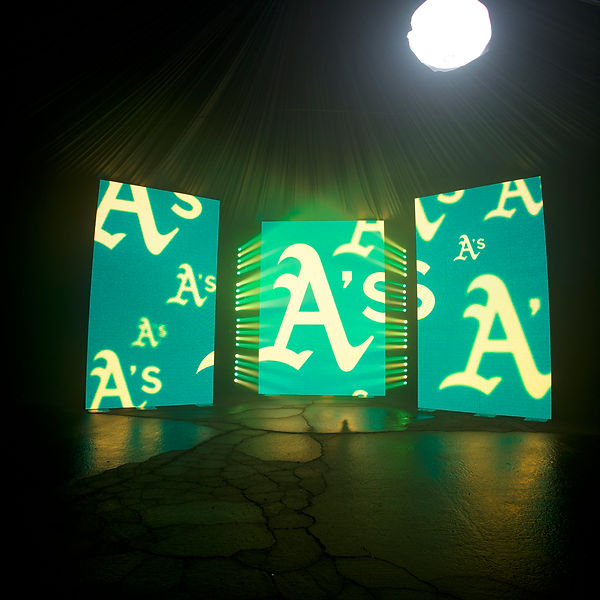
Define what this particular canvas is allowed to say
Start with a narrow content brief: event identity, approved colors and any permitted supporting message. Decide whether the booth should remain visually secondary to other reception signage. A compact surface is rarely the right place for detailed schedules, long disclaimers or multiple competing sponsor messages.
Confirm whether the proposed LED arrangement is suitable for the location with the production team and venue. Do not assume a decorative concept establishes a safe physical configuration. Structural support, power and any rigging require qualified professionals and venue approval; exact LED configurations need a quote.
Build loops that do not feel like repeated announcements
A reception loop should work when someone notices it halfway through. Favor self-contained visual compositions over a story that requires watching from the beginning. If a logo appears only briefly between long transitions, many guests may never see the intended identity.
Review the join between the end and beginning of the loop. An obvious jump, black frame or sudden brightness change can make a background element repeatedly call attention to itself. Ask for a playback test rather than relying only on a design preview.
Keep motion measured and avoid rapid flashing. Visual energy does not have to track every musical change. In a hypothetical Tempe corporate reception, a slow color movement with a stable event mark could support the room better than constant text changes.
Design the announcement state before the party state
When someone begins a welcome or recognition, the visual priorities change. Decide whether the booth should show a static event identity, an announcement-specific title or a subdued neutral background. Continuing a busy loop can draw attention away from the person speaking.
The transition should have an owner and a recognizable cue. Coordinate the visual change with the audio team and the person managing announcements, without assuming music and display playback share a control system. Specify who requests the change, who executes it and what signals the return to reception content.
Avoid automatic returns based only on elapsed time. Remarks may run longer than expected. A held announcement state gives the operator a clear place to remain until the designated person confirms the segment has ended.
Approve real layouts and restrict last-minute substitutions
Obtain the actual content dimensions and a diagram of visible regions before final design. Booth surfaces can have proportions, divisions or viewing obstructions that make a standard video unsuitable. Keep logos intact and place essential elements where they will remain visible from expected guest positions.
The final approval should cover the complete playback set, including loop transitions and the announcement hold. Establish who can authorize substitutions during the reception. A well-intended replacement file may introduce an outdated logo, unrelated imagery or an unreadable message if nobody owns that decision.
- Approve the brand elements allowed on the booth surface.
- Test the loop seam on the intended playback system.
- Provide a static announcement hold.
- Name the visual cue owner and return-to-loop signal.
- Keep an approved neutral graphic available.
Put the plan into practice
Treat reception booth visuals as controlled corporate content, not open-ended decoration. A restrained loop, a clean announcement state and a clear approval path keep the display useful throughout the reception.
LED video wall rental and production