
Designing a Truss Build for an Arizona Event
A custom truss build can be the difference between an event that looks polished and one that looks improvised. Whether you're hanging a single moving-light bar for a corporate keynote or building a festival mainstage roof at Tempe Beach Park, the principles are the same: pick the right configuration, pick the right brand, engineer the load, plan the ballast, and pull the permits. This guide walks through each.
Need a specific quote? See Global Truss Rental Phoenix, Scottsdale, Bolt Truss Rental Phoenix, or Tempe.
Configurations: Pick the Right Shape
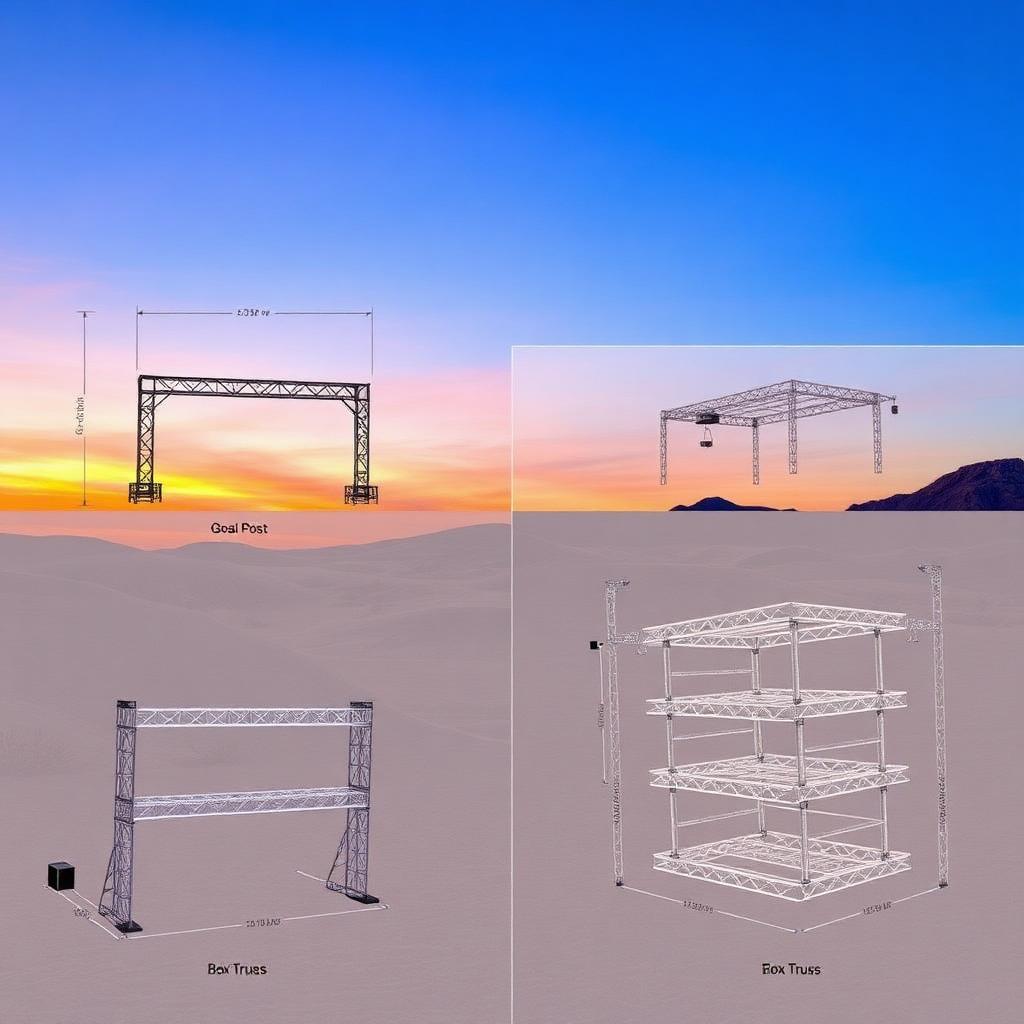
Goal Post
Two vertical towers + one horizontal header. The workhorse for corporate keynotes, brand activations, and concert backdrops. 20–30 ft spans.
Truss Arch
Single, double, or full-circle curved truss. Weddings, brand entrances, finale photo moments. 60–90 minute install.
Ground-Supported Grid
Four-leg square or rectangular grid with motors. Holds full lighting rig + LED frame. The default for outdoor builds with no rigging.
Flown Lighting Grid
Multiple truss runs flown from venue rigging points using chain motors. Standard for arena and theater concert work.
Tower & Roof System
Four-tower bolt truss system with rated roof — Tomcat or Pro X for festival mainstages and outdoor concerts at scale.
Custom Brand Lock-Up
DJ booth surrounds, LED arch frames, geometric brand lock-ups, finale headers — engineered to your creative.
Brands: When to Use Which
Global Truss F34
Use for: Most corporate, wedding, brand-activation builds. Goal posts, arches, small-to-mid grids.
Strength: Modular, affordable, fast assembly. Accepted everywhere.
Global Truss F44
Use for: Longer spans (>30 ft), heavier LED walls, tall towers (>22 ft trim).
Strength: Heavier-duty spigot truss for when F34 maxes out.
Tomcat Box Truss
Use for: Arena flown grids, festival mainstages, touring buyouts, heavy LED walls.
Strength: Industry-standard touring quality. Accepted at every venue.
Pro X Heavy-Duty
Use for: Cost-effective bolt truss for corporate concerts, buyouts, and fixed installs.
Strength: Solid bolt truss without the touring-brand price tag.
Tyler GT
Use for: Mid-size arena rigging and stadium pre-show builds.
Strength: Decades of arena history; still widely used in mid-size touring.
Loads, SWL & Engineering
Every truss has a manufacturer-published load chart — Safe Working Load (SWL) varies by span, support type (simple vs cantilever), and load distribution (UDL vs point loads). The build engineer adds up everything hanging (fixtures, LED, drape, cable, motors, hardware), distributes the point loads against the chart, and confirms the total stays well inside SWL with a safety margin.
For a typical 20-ft Global Truss F34 goal-post header, you can hang 6–12 moving heads and lighting accessories without breaking a sweat. For longer spans or heavier LED walls, the engineer either moves to F44, moves to bolt truss (Tomcat 20.5"/26" or Pro X F44P), or adds support points to reduce the span.
Ballast & Arizona Wind
Outdoor ground-supported truss has to resist wind tipping the structure. Ballast is calculated against expected wind using NFPA 102 (the U.S. tent/structure standard) and the manufacturer's spec sheet. Arizona-specific considerations:
- Monsoon season (June–September): Sudden 40+ mph gusts and microbursts. We engineer summer outdoor builds with a 40–50 mph wind contingency and a documented strike plan if NWS issues a warning.
- High Country (Flagstaff, Prescott, Sedona): Different wind profile, occasionally snow load in spring/fall builds.
- Desert wind: Even outside monsoon, afternoon thermals can produce 25–35 mph gusts. Standard outdoor builds use a 35 mph minimum.
- Ballast types: 55-gallon water barrels (~455 lbs filled), concrete eco-blocks (~3,500 lbs), jersey barriers (~4,000 lbs), or engineered base plates with anchor straps.
Permits Across the Valley
- Phoenix: Special Event Permit + temporary structure permit through Planning & Development. $2M GL insurance with city named additional insured.
- Scottsdale: Special Event Permit through the City of Scottsdale Special Events Office. Resort property builds governed by property banquet ops.
- Tempe: Special Event Permit through Community Services. Strict 10 PM weekday / 11 PM weekend amplified-sound curfew.
- Mesa: Special Event Permit through City of Mesa. Temporary structure permit if over the city threshold.
- State / Federal Land: Arizona State Parks, USFS (Coconino, Tonto, Prescott), and BLM events require federal/state special-use permits with longer lead times (often 60–90 days).
Decision Walkthrough
- Indoor or outdoor? Outdoor = ground-supported + ballast. Indoor = ground-supported or flown depending on venue rigging.
- What are you hanging? Total weight + heaviest single point load. That picks the truss series.
- How long is the span? Under 30 ft = Global Truss F34 likely fine. Over 30 ft = F44 or bolt truss.
- How tall does it trim? Under 22 ft = sleeve blocks fine. Over 22 ft = bolt truss tower system.
- What's the aesthetic? Galas/awards = black-anodized. Festivals/concerts = silver or natural mill finish.
- Lead time? Resort galas 6–10 weeks, weddings 3–6 months, festival mainstages 8–12 weeks, last-minute corporate sometimes 2 weeks.
Case Study: Custom Brand Lock-Up
A national retail brand wanted a 16-ft tall geometric truss lock-up as the hero photo moment at a Scottsdale resort activation. We designed a custom Global Truss F34 structure combining straight sections, 90° corners, and curved arch pieces wrapped in printed brand vinyl with hidden LED rope along the inside edges. The lock-up was free-standing on engineered base plates (no ballast needed indoors), installed in 3 hours, and survived three days of guest traffic without issue. The structure showed up in 4,200 user-generated Instagram posts — the brand's strongest activation ROI of the year.
Truss Build FAQ
What is event truss and what is it used for?
Event truss is modular aluminum structure used to support stage lighting, LED video walls, PA speakers, drape, banners, and signage. Modern event production almost always uses pre-engineered truss from manufacturers like Global Truss, Tomcat, Pro X, or Tyler — each section is tested, rated, and predictable to load.
How do I know what kind of truss build I need?
It comes down to two questions: (1) What does the truss need to hold? (2) What's the venue? A small corporate keynote at a hotel ballroom is usually a single Global Truss F34 goal-post. A festival mainstage at Tempe Beach Park is a Tomcat or Pro X four-tower roof system with ballast. Send us the venue and what you're hanging — we'll spec it.
What's the difference between spigot truss and bolt truss?
Spigot truss (Global Truss F34/F44) connects with conical couplers and safety pins — fast assembly, lighter weight. Bolt truss (Tomcat, Pro X, Tyler) connects with steel bolts through corner blocks — higher load capacity, longer spans, better fatigue life. Spigot for corporate/wedding, bolt for arena/festival.
Which truss brand is best?
Each brand serves a use case. Global Truss is the global standard for spigot truss — affordable, modular, accepted everywhere. Tomcat is the touring standard for bolt truss — premium pricing, exceptional QC, accepted at every arena. Pro X is the cost-effective bolt truss for buyouts and corporate concerts. Tyler GT has decades of arena rigging history and is still widely used in mid-size touring.
When do I need bolt truss instead of Global Truss F34?
Move to bolt truss when you're spanning more than 30 feet between supports, flying an LED video wall over ~1,500 lbs, building a tower over 22 feet tall, or running an arena-scale touring rig. Global Truss F34 covers most corporate, wedding, and brand-activation builds.
What is ground-supported truss and when do I need it?
Ground-supported truss is a freestanding truss structure with sleeve blocks on engineered base plates and ballast — no rigging from above. Used outdoors (no rigging available) and in venues without rated rigging points. The vast majority of Arizona outdoor event truss is ground-supported.
How much ballast do I need for an outdoor truss build?
Ballast is calculated against expected wind load using the manufacturer's spec sheet and NFPA 102. A typical 20-ft goal-post in normal conditions might need 800–1,200 lbs per leg; a 30-ft tower with a roof might need 2,000+ lbs per leg. Arizona monsoon season (June–September) requires extra margin. We provide the engineered ballast calc with every outdoor build.
Can I build a truss arch for a wedding?
Yes — truss arches are one of our most popular wedding builds. Single-leg arches, double arches, and full-circle arches built from curved Global Truss F34 segments. Dressed with florals, drape, LED rope, or vinyl. Installs in 60–90 minutes and works on resort lawns, private estates, and ballroom settings.
Do I need permits for an outdoor truss build in Arizona?
Almost always yes for public-property events. Each Arizona city has a Special Event Permit process (Phoenix, Scottsdale, Tempe, Mesa, Chandler all have one), and structures over a certain size require a temporary structure permit through the city's planning department. Resort and private estate builds are governed by the property's banquet ops, not the city.
How much does a custom truss build cost?
Custom truss pricing depends on configuration (goal post, arch, grid, tower), truss series (Global Truss vs bolt truss), motors, ballast, crew, and permits. A simple wedding truss arch is one price point; a festival mainstage tower system with roof is another. All quotes include engineered drawing, hardware, build crew, and strike.
Who provides the engineered drawing for a truss build?
We do. Every truss build we quote includes a stamped engineered drawing showing truss runs, motor positions (if flown), point loads, total weight, ballast schedule (if ground-supported), and SWL margins. The drawing is what the city, resort, or venue needs to approve the build.
How long does a truss build take to install?
A simple wedding arch installs in 60–90 minutes. A 20-ft corporate goal post takes 2–4 hours. A 30x20 ground-supported grid takes 4–8 hours. A festival mainstage tower system with roof takes 1–2 days with a full crew. Build times are part of every quote so the venue load-in window is accurate.
Can you integrate truss with LED video walls and stage rental?
Yes — most custom builds are integrated. Truss frame + LED wall + portable stage + PA rigging + intelligent lighting, all designed as one system on a single drawing. See our LED Video Wall Rental and Stage Rental pages for those inventories.
Do you build truss across the whole Phoenix metro?
Yes — Phoenix, Scottsdale, Tempe, Mesa, Chandler, Gilbert, Glendale, Peoria, Surprise, Fountain Hills, Cave Creek, and Paradise Valley. We also serve Tucson, Flagstaff, Sedona, and Prescott for larger productions with sufficient lead time.
Can other production companies rent truss from you?
Yes — we sub-rent Global Truss F34/F44 and bolt truss (Tomcat, Pro X, Tyler) inventory to vetted Arizona production companies and touring buyouts. Send your dates, build list, insurance certificates, and rigging credentials.